
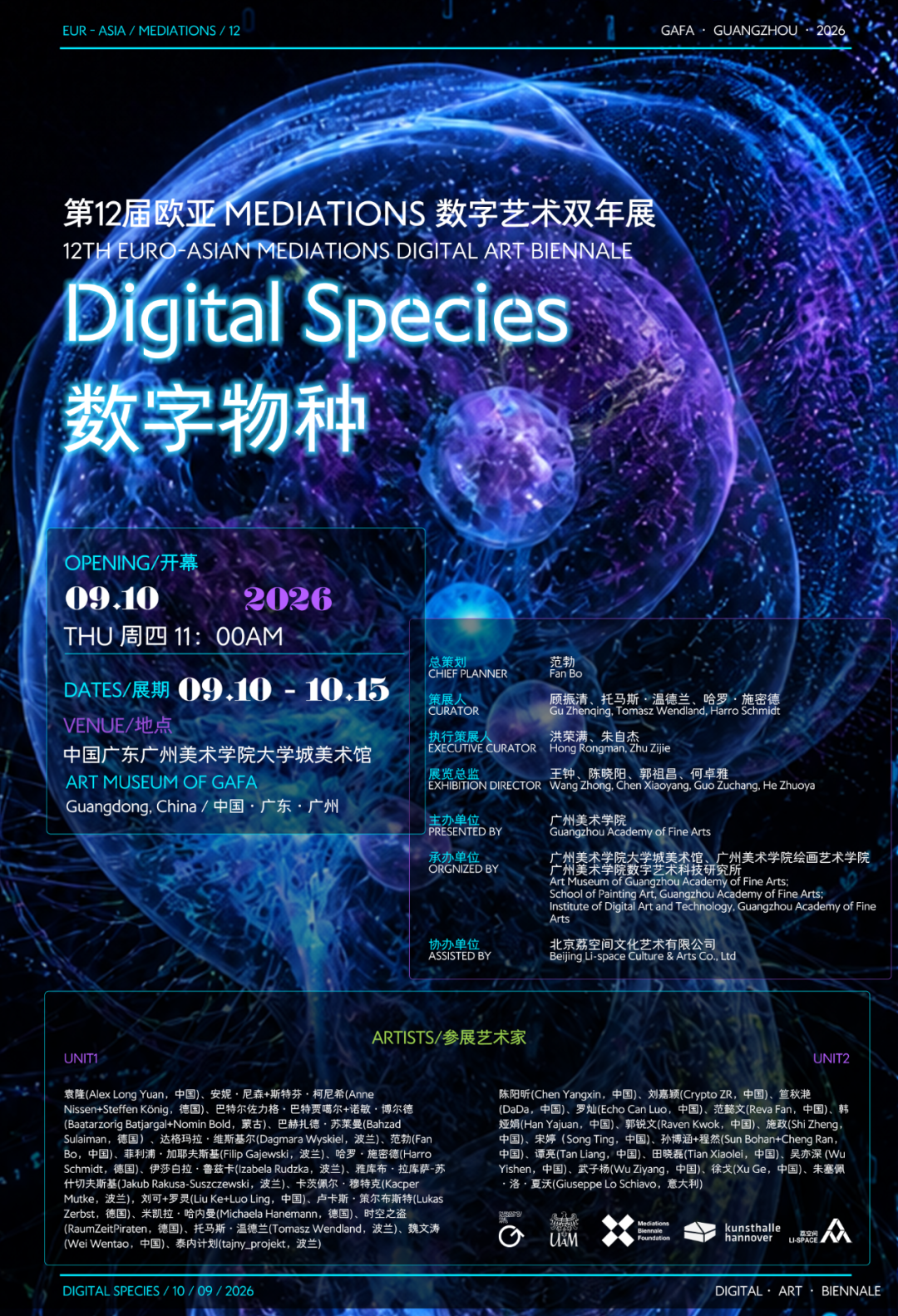
数字物种:第12届欧亚MEDIATIONS数字艺术双年展
Digital Species: 12th Euro-Asian Mediations Digital Art Biennale
展期:2026年9月10日—10月15日
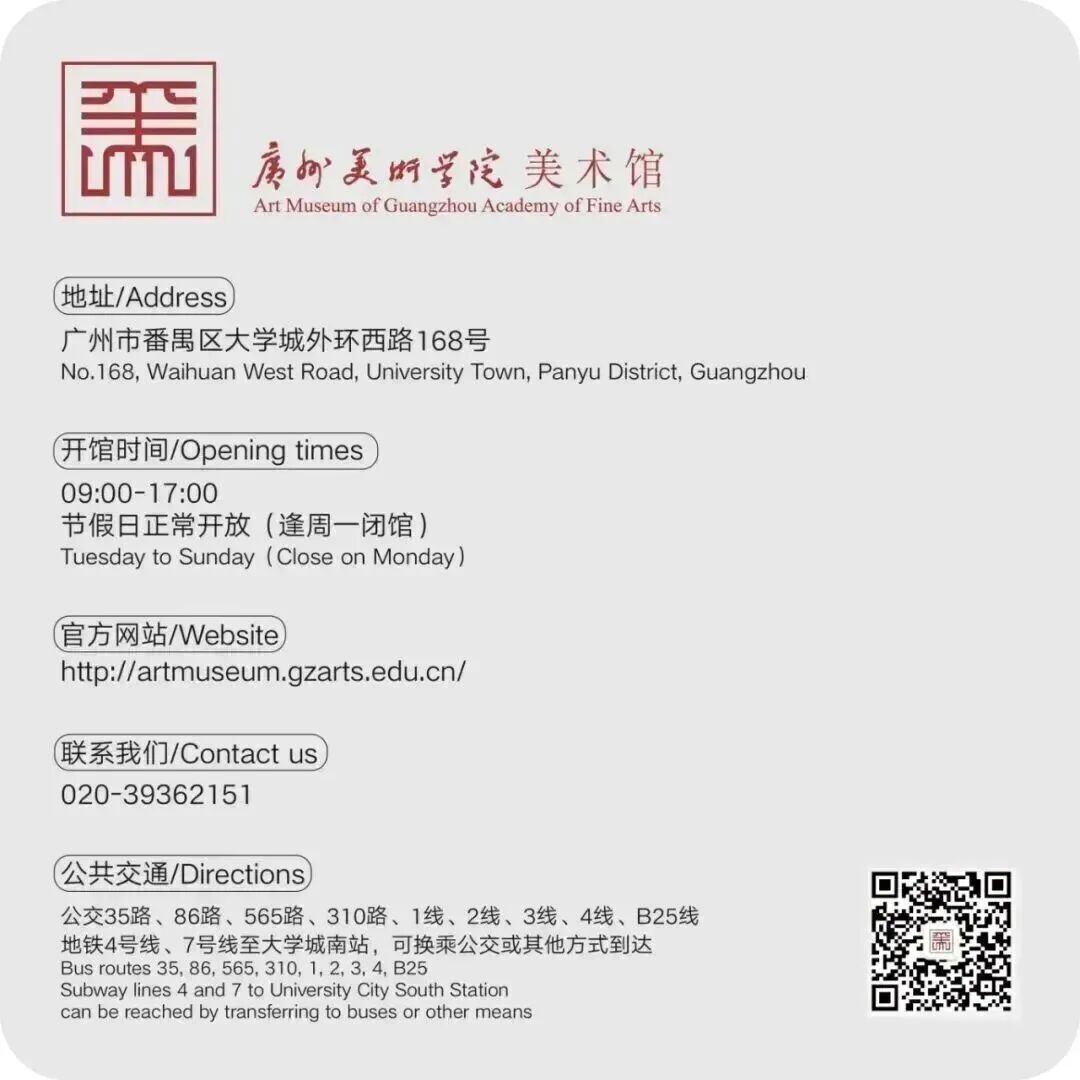
地点:广州美术学院大学城美术馆1—4号厅、负一楼展厅
开幕时间:2026年9月10日(周四)上午11:00
主办单位:广州美术学院
承办单位:广州美术学院大学城美术馆、广州美术学院绘画艺术学院、 广州美术学院数字艺术科技研究所
协办单位:北京荔空间文化艺术有限公司
总策划:范勃
策展人:顾振清、托马斯・温德兰、哈罗・施密德
执行策展人:洪荣满、朱自杰
展览总监:王钟、陈晓阳、郭祖昌、何卓雅
策展助理:曾伟峰、邓子军
交流协助:唐馥敏
展览统筹:李铁军
传播教育:王秀媛、余爽、刘子瑗
行政支持:王潇涵
展厅管理:何泉、黄兴彪
视觉设计:黄子乐、吴晨羽、刘星辰
参展艺术家
第一单元:
袁隆(中国)、安妮·尼森+斯特芬·柯尼希(德国)、巴特尔佐力格·巴特贾噶尔+诺敏·博尔德(蒙古)、巴赫扎德·苏莱曼(德国)、达格玛拉·维斯基尔(波兰)、范勃(中国)、菲利浦·加耶夫斯基(波兰)、哈罗·施密德(德国)、伊莎白拉·鲁兹卡(波兰)、雅库布·拉库萨-苏什切夫斯基(波兰)、卡茨佩尔·穆特克(波兰)、刘可+罗灵(中国)、卢卡斯·策尔布斯特(德国)、米凯拉·哈内曼(德国)、时空之盗(德国)、托马斯·温德兰(波兰)、魏文涛(中国)、泰内计划(波兰)
第二单元:
陈阳昕(中国)、刘嘉颖(中国)、笪秋滟(中国)、罗灿(中国)、范懿文(中国)、韩娅娟(中国)、郭锐文(中国)、施政(中国)、宋婷(中国)、孙博涵+程然(中国)、谭亮(中国)、田晓磊(中国)、吴亦深(中国)、武子杨(中国)、徐戈(中国)、朱塞佩·洛·夏沃(意大利)
DATES: Sept. 10 to Oct. 15, 2026
VENUE: Hall 1 to Hall 4 & Basement 1, Art Museum of Guangzhou Academy of Fine Arts (University Town Campus)
OPENING: 11:00,September 10, 2026 (Thu.)
PRESENTED BY: Guangzhou Academy of Fine Arts
ORGNIZED BY: Art Museum of Guangzhou Academy of Fine Arts, School of Painting Art, Guangzhou Academy of Fine Arts, Institute of Digital Art and Technology, Guangzhou Academy of Fine Arts
ASSISTED BY: Beijing Li-Space Culture & Arts Co., Ltd.
Chief Planner: Fan Bo
Curators: Gu Zhenqing, Tomasz Wendland, Harro Schmidt
Executive Curators: Hong Rongman, Zhu Zijie
Exhibition Directors: Wang Zhong, Chen Xiaoyang, Guo Zuchang, He Zhuoya
Curatorial Assistant: Zeng Weifeng, Deng Zijun
Communication Assistant: Tang Fumin
Exhibition Coordination: Li Tiejun
Disseminate Education: Wang Xiuyuan, Yu Shuang, Liu Ziyuan
Administrative Support: Wang Xiaohang
Exhibition Hall Management: He Quan, Huang Xingbiao
Visual Design: Huang Zile, Wu Chenyu, Liu Xingchen
ARTISTS
SECTION ONE:
Alex Long Yuan (China), Anne Nissen+Steffen König (Germany), Baatarzorig Batjargal+Nomin Bold (Mongolia), Bahzad Sulaiman ( Germany), Dagmara Wyskiel (Poland), Fan Bo (China), Filip Gajewski (Poland), Harro Schmidt (Germany), Izabela Rudzka (Poland), Jakub Rakusa-Suszczewski (Poland), Kacper Mutke (Poland), Liu Ke+Luo Ling (China), Lukas Zerbst (Germany), Michaela Hanemann (Germany), RaumZeitPiraten (Germany), Tomasz Wendland (Poland), Wei Wentao (China), Tajny_projekt (Poland)
SECTION TWO:
Chen Yangxin (China), Crypto ZR (China), DaDa (China), Echo Can Luo (China), Reva Fan (China), Han Yajuan (China), Raven Kwok (China), Shi Zheng (China), Song Ting (China), Sun Bohan+Cheng Ran (China), Tan Liang (China), Tian Xiaolei (China), Wu Yishen (China), Wu Ziyang (China), Xu Ge (China), Giuseppe Lo Schiavo(Italy)
前言1
PREFACE I
数字物种:AGI文明临界点的艺术预言
文 / 顾振清,策展人
数字技术、互联网技术、区块链技术以及AI大模型技术的爆发,为艺术家打开了一个奇妙的数字伊甸园。艺术家的作品不再执着于审美、装饰、疗愈,而是立足于启智、知识生产,以释放创造潜能、突破认知局限。人类社会的数字化革命、AI化转型的大趋势已不可逆。在碳硅更替的当下,更多艺术家聚焦数字AI时代所揭示的认知跃迁的现象与本质,反思科学与新兴技术给人类生活方式和整个人类文明带来的巨大迁移、转型及其潜在危机。在价值多元化、文化多样化的思潮下,以分布式、可持续、自组织、自治理、超链接、永久刷新为亮色的后当代艺术,正在许多全球南方国家不断发展、扩容,占据数字艺术的前沿。后当代艺术渐渐成为消解中心与边缘、确定性与非确定性的二元结构的文化载体与社交媒介。
当0与1二进制的代码艺术、程序艺术的激浪冲破屏幕边界,算法不再只是冰冷的逻辑指令,而是在像素与数据的褶皱中生长的一种全新“生命形态”,即虚拟世界中气象万千的数字物种。数字物种脱胎于一场艺术与科技共谋的造物实验。它们或许没有血肉之躯,却带着艺术家赋予的感知与叙事;它们诞生于代码的胚胎,却在人机交互中生成独特的行为轨迹。数字物种可能是随观众的呼吸而生长的像素藤蔓,可能是响应声波而绽放的虚拟共生体,也可能是数据洪流中不断演化的形态集群。在这里,“物种”的定义被重新书写。生命不再局限于碳基的桎梏,创意也突破了物理的边界。每一件作品都是艺术家与机器对话的结晶,是数字时代“生命意识”的一次温柔觉醒。
科学与艺术探索的是不同程式的真理,有各自的知识生产标准与认知迭代模式。但在发现宇宙规律及其真相的底层逻辑上,科学家、程序员的科技发明力与艺术家的艺术创造力其实是相通的。艺术家在知识生产上的特殊角色,就是立足于科学推理与科学实验之上的一种继续想象的特权。因为艺术家的直觉和想象力,可以跨出科学原理的密封舱,感知并彰显外在世界其他未知、隐秘和混沌的面相。AGI即将爆发、奇点正在降临。在这场未知的人类文明变局中,艺术跳出了单纯的审美创作维度,成为预判未来、审视危机、锚定人性的先锋力量。当代艺术家不再只是美的创作者,更是时代的预言家。相较于技术的功利迭代与理性推演,艺术以直觉、思辨与想象力,穿透技术迷雾,提前窥探数字物种的演化轨迹、人机共生的全新秩序,以及文明存续的无数可能与隐患。
本次《数字物种》展览,立足AGI文明临界点,以艺术为观测窗口,直面数字物种爆发的时代命题。通过艺术的先锋叙事,解构超级智能的技术本质、文明危机与价值困境,探讨技术加速与人文制衡、机器演化与人性坚守、无序迭代与超级对齐的深层关系,以艺术预言回应时代焦虑,为人类文明的发展存续,探寻人机共生的全新答案。
Digital Species: Artistic Prophecy at the Critical Threshold of AGI Civilization
By Gu Zhenqing, curator
The explosive growth of digital technology, internet technology, blockchain technology, and large AI models has opened up a wondrous digital Eden for artists. Artists’ works are no longer confined to aesthetics, decoration, or healing. Instead, they are grounded in intellectual enlightenment and the production of knowledge to unleash creative potential and break through cognitive limitations. The overarching trends of the digital revolution and AI-driven transformation in human society are now irreversible. Amid the current shift from carbon to silicon, more artists are focusing on the phenomena and essence of the cognitive leaps revealed by the digital AI era, reflecting on the massive shifts, transformations, and potential crises that science and emerging technologies bring to human lifestyles and civilization as a whole. Amid trends toward value pluralism and cultural diversity, Post-contemporary art—defined by its hallmarks of decentralization, sustainability, self-organization, self-governance, hyperlinking, and eternal updating—is continuously evolving and expanding in many countries of the Global South, taking the lead in the field of digital art. Post-contemporary art is gradually emerging as a cultural vehicle and social medium that dissolves the binary structures between center and periphery, and between certainty and uncertainty.
When the surging waves of binary code art and program art—composed of 0s and 1s—break through the boundaries of the screen, algorithms are no longer merely cold, logical instructions, but a brand-new “form of life” growing within the folds of pixels and data: the diverse digital species of the virtual world. These digital species are born from a creative experiment in which art and technology collaborate. They may lack physical bodies, yet they carry the perceptions and narratives bestowed upon them by artists; they are born from the embryo of code, yet generate unique behavioral trajectories through human-machine interaction. Digital species may be pixel vines that grow with the audience’s breath, virtual symbiotic organisms that bloom in response to sound waves, or clusters of forms constantly evolving within a torrent of data. Here, the definition of “species” is rewritten. Life is no longer confined to the shackles of carbon-based existence, and creativity has broken through physical boundaries. Each work is the crystallization of a dialogue between the artist and the machine—a gentle awakening of “consciousness of life” in the digital age.
Science and art explore truths through different methodologies, each with distinct standards for knowledge production and cognitive iteration. Yet at the foundational level of uncovering cosmic laws and their underlying logic, the inventive power of scientists and programmers aligns with the creative force of artists. The unique role of artists in knowledge production lies in their privileged capacity for continued imagination, grounded in scientific reasoning and experimentation. For it is through an artist's intuition and imagination that one can step beyond the sealed chamber of scientific principles to perceive and reveal other unknown, hidden, and chaotic facets of the external world. AGI is on the verge of a breakthrough, and the Singularity is approaching. Amid this unforeseen upheaval of human civilization, art transcends the dimension of pure aesthetic creation and emerges as a vanguard force to predict the future, examine crises and anchor human nature. Contemporary artists are no longer mere aesthetic creators, but seers of the era. Unlike utilitarian technological advancement and rational deduction, art pierces through the haze of technology via intuition, speculation and imagination, offering an early glimpse into the evolutionary trajectory of digital species, the brand-new order of human-machine coexistence, as well as countless possibilities and hidden dangers concerning the sustainability of civilization.
Centered on the tipping point of AGI civilization, the exhibition Digital Species takes art as an observational lens to confront the epochal theme of the explosion of digital species. Through avant-garde artistic narratives, it deconstructs the technological essence, civilizational risks and value dilemmas of superintelligence, and delves into the profound interplay between technological acceleration and humanistic checks, mechanical evolution and adherence to humanity, unregulated iteration and superalignment. With artistic prophecy responding to the anxieties of our age, this exhibition seeks innovative solutions for harmonious coexistence between humans and machines to secure the long-term survival of human civilization.
前言2
PREFACE II
尺度
文/托马斯·温德兰,策展人
人类可观测到的宇宙尺度,从10⁻³⁵米的微观量子世界延伸到8.8×10²⁶米的宏观范围,相当于920亿光年。
本次展览通过科技与艺术,超越我们的感官与想象,将我们的认知能力延伸至想象力的边界之外。通过改变图像的尺度,我们改变了感知视角,而人体尺度不再被视为宇宙的衡量标准。那么,如果人体不再是其尺度的基础,又会如何呢?展览精选模拟媒介与数字媒介作品,以静态图像与动画相互交织的方式,构筑出一个富有感官体验、通透空灵的空间。
Scale
By Tomasz Wendland, curator
The scale of the universe observable by humans is in the range between micro: It begins in the quantum world (on the order of \ (10^{-35}\) meters) and goes to Macro scale: The diameter of the observable universe is about(8{,}8 \times 10^{26}\) meters, or as much as 92 billion light years in each direction.
This exhibition reaches beyond our senses and imagination through technology and art, which extend our competence beyond the limits of our imagination. By changing the scale of images, we change our perspectives of perception, and the body ceases to count as the measure of the universe. So what, then if not a human body is the foundation of its scale? Selected analogue and digital works, as stills and animation will inter-fear creating one sensual and transparent space.
前言3
PREFACE III
物质的共振
文/哈罗·斯密德,策展人
“物质的共振”是一个多媒体项目,汇集了探索光与能量过程的艺术实践。项目将这些作品(其中部分具有互动性)视为艺术事件来呈现,通过艺术手段,探讨传递与接收、信号与响应、涌现与余波等过程。在此语境下,物质的“辉光”指代光辐射的瞬间,源自光源的光芒、光束以及能量场。而“共振”则指随之而来的现象——在空间中展开并在身体内部持续的反射、振动、反馈与残像。展览在两种力量之间游走,一种是向外的运动,另一种是向内或穿透的运动。它探索信号如何转化为一种氛围,以及当源头消失后,存在感如何依然持续。光不仅作为一种可见现象,更是引发物质、空间、物理和时间层面反应的触发器。
项目的策展理念力图确保每一种艺术立场都能使这两种运动同时显现,从而营造出整体的连贯性。每件作品都融合了“辐射”与“共振”两个要素。这种回应十分微妙,可能是一抹几乎难以察觉的阴影、一阵轻柔的嗡鸣、一个具有反射性的物体、一段记录下的痕迹,或是投影。由此形成信号与反馈的网络,作品彼此影响,展览空间本身也成为了一个共振体。“物质的共振”邀请我们体验感知作为一种循环过程——即发射与回声、存在与余韵之间的相互作用。展览不仅探讨“可见之物”,更关注“残留之物”、“响应之物”,以及在空间中两者的持续共鸣。
广州美术学院美术馆坐落于广州大学城这一充满活力的高等教育超级中心的核心地带,是广东省当代艺术和新锐人才的灯塔。这里不仅仅是美术馆,更是中国最负盛名的艺术学院之一的创意核心,为参观者打开了一扇充满活力且鼓舞人心的窗口,让他们得以一窥中国艺术与设计的未来。其现代建筑风格和精心策划的展览,使其成为艺术爱好者、学生以及游客不可错过的去处。作为欧亚数字艺术双年展的一部分,汉诺威艺术协会艺术馆将展出五件来自德国的作品,并结合五件波兰作品,围绕该主题与中国艺术家及其作品展开对话。
Resonance of Matter
By Harro Schmidt, curator
Resonance of Matter brings together artistic practices that explore the processual nature of light and energy in a multimedia project, framing their works—some of which are interactive—as events. Through artistic means, the project examines processes of transmission and reception, signaling and response, emergence and aftereffects. In this context, radiance refers to the moment of emission: the glow, the beam, the energetic field emanating from a source. Resonance, on the other hand, is what follows—reflections, vibrations, feedback, and afterimages that unfold in space and continue within the body. The exhibition moves between these two forces: a movement outward and a movement back or through. It explores how a signal becomes an atmosphere and how presence persists even when its source has vanished. Light appears not only as a visible phenomenon but as a trigger for reactions—material, spatial, physical, and temporal.
The curatorial concept creates coherence by ensuring that each artistic stance makes both movements visible. Each work incorporates an element of radiation and an element of resonance. The response can be subtle: a barely perceptible shadow, a soft hum, a reflective object, a recorded trace, or a secondary projection. This creates a network of signals and feedback in which works influence one another and the exhibition space itself becomes a resonating body. Resonance of Matter invites us to experience perception as a circular process—as an interplay of emission and echo, of presence and reverberation. The exhibition asks not only what is visible, but what remains, what responds, and what continues to resonate in the space in between.
Art Museum of Guangzhou Academy of Fine Arts (GAFA) nestled in the heart of Guangzhou’s vibrant Higher Education Mega Center (University Town). Art Museum of the Guangzhou Academy of Fine Arts (GAFA) stands as a beacon of contemporary art and emerging talent in Guangdong Province. More than just a gallery, this institution is the creative heart of one of China’s most renowned art academies, offering visitors a dynamic and inspiring window into the future of Chinese art and design. Its modern architecture and thoughtful curation make it a must-see for art lovers, students, and curious travelers exploring the Panyu district. As part of Euro-Asian Digital Art Biennale, the Kunstverein Kunsthalle Hannover will present five works from Germany and, together with five Polish works, will open a platform for dialogue with Chinese artists and their works on the theme.
编辑 | 余 爽
审核 | 王秀媛 刘子瑗
审定 | 陈晓阳 洪荣满
评论 (0)
登录后才能发表评论。
登录 / 手机号注册暂无评论,来发表第一条吧。